This post was originally published on this site.
My pursuit of hand‑forged blades across Southeast Asia began with a simple spark—the desire to find blades that carried history in their steel. That search quickly grew into a journey across borders, temples, and marketplaces, where the clang of hammer on anvil revealed traditions still alive today. Until this trip, I had rarely stood inside a working forge, watching steel take shape before my eyes. That changed in my travels!
Advertisement — Continue Reading Below
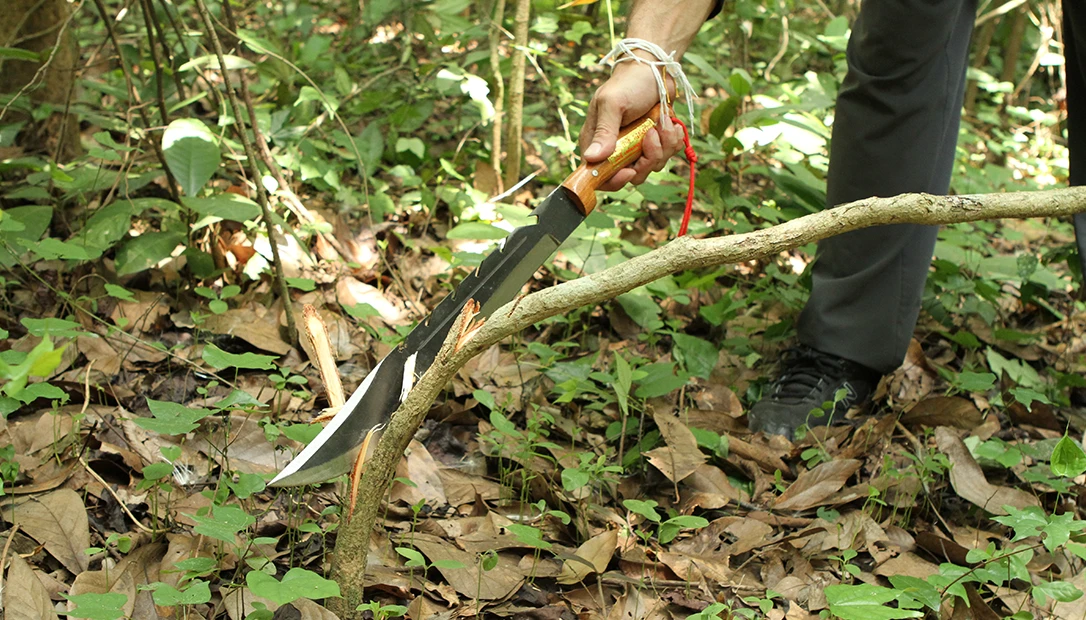
Malaysian Parangs
The parang stands as Malaysia’s answer to the machete—a chopping blade with deep roots in local tradition. In modern cutlery, it’s one of the most copied designs, though most commercial versions fall short of the real thing. Authentic parangs carry a balance and build that imitators rarely capture.
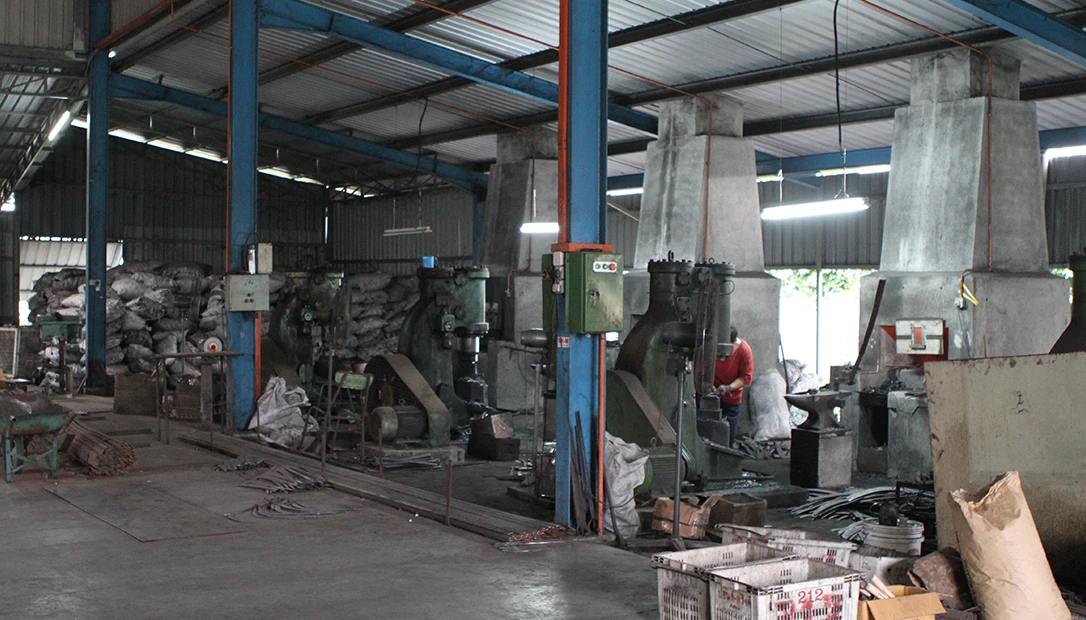
My journey to see them firsthand took me to Penang, where my friend Ahmad Nadir joined me for a road trip to Bidor. That town is home to the forges that produce Malaysia’s most respected parangs. Walking into the shop, I was struck by how modern the facility felt compared to the rustic forges I had visited in Thailand and the Philippines.
The Bidor Forge
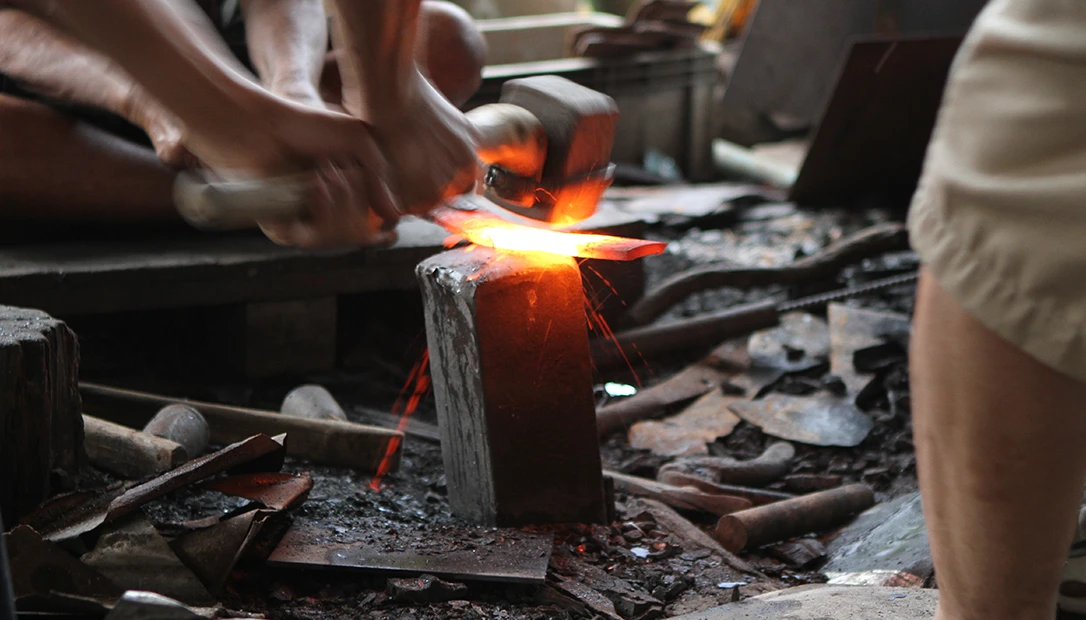
Coal once fueled the fires here, but the smiths have since upgraded to gas forges. Power hammers now drive the work, speeding up production while maintaining quality. The atmosphere had a more assembly-line rhythm, with six stations laid out in sequence. Each had its own forge for heating steel, an anvil for shaping, a quenching tub, and an automatic hammer.
Advertisement — Continue Reading Below
This forge didn’t just make parangs. Knives, axes, and agricultural tools filled the order books, supplying much of Malaysia with working steel. Still, their specialty remained the parang, and no other shop I knew of exported authentic Malaysian parangs worldwide—except Outdoor Dynamics (now, My Parang), which carried the Bidor brand beyond local borders.
The Bidor Parang Design
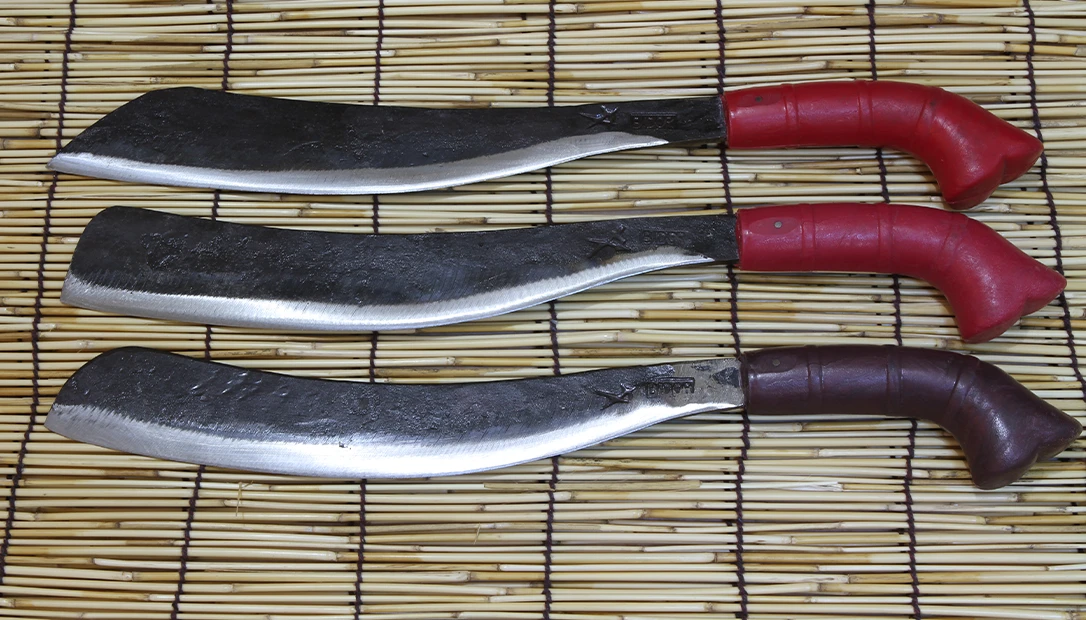
Bidor parangs are instantly recognizable by their plastic handles, usually red or purple. The construction uses a stick tang, but with a clever addition: a metal pin driven through both handle and blade. That simple reinforcement prevents the dreaded mishap of a blade separating from its grip.
The smiths produce several traditional styles, each with subtle differences that demand years of experience to master. Among them are the Chandong, Kota Belud, Bentong, and the Ray Mears‑inspired parang. Every model carries its own nuances in curve, weight, and edge geometry. Capturing those distinctions requires not just skill with hammer and forge, but an understanding of the cultural heritage behind each blade.
Advertisement — Continue Reading Below
Modern Hand-Forged Blades
Standing in the Bidor workshop, I saw how Malaysia’s parang makers blend old forms with modern tools. Gas forges and power hammers may speed the process, but the artistry remains in the hands of the smiths. Each blade is hammered with care, quenched with precision, and finished to serve both farmers in the field and adventurers abroad.
The parang is more than a machete. It’s a symbol of Malaysia’s working heritage, a blade designed for clearing jungle paths, chopping wood, and tackling the hard labor of daily life. In Bidor, that tradition continues—refined, modernized, but never forgotten!
Advertisement — Continue Reading Below
Ayutthaya, Thailand
My first visit to Thailand was through the lens of a camera, drawn to subjects that seemed made for photography. In the crowded markets, knives were everywhere—used to break down chickens, slice fruit, and prep food in the open kitchens of street vendors. Each blade told a story of utility and culture.
After a few days, I heard of a village about five hours from Pattaya. The destination was Ayutthaya, once the capital of Siam and a dominant force in mainland Southeast Asia. Today, tourists flock there for temples and ruins, but my mission was different. I wanted to see Aranyik, the legendary knife‑making village.
At Wiai Roeycharoen Knife Shop, I found what I was looking for. Heavy chopping blades lined the walls, each forged in the traditional style. The village participates in Thailand’s OTOP (One Tambon One Product) program, a national effort to highlight unique goods from each sub‑district. Products selected as “starred OTOP” gain recognition far beyond their local roots, giving artisans a platform to showcase their craft to the world.
Advertisement — Continue Reading Below
Inside the Aranyik Forge
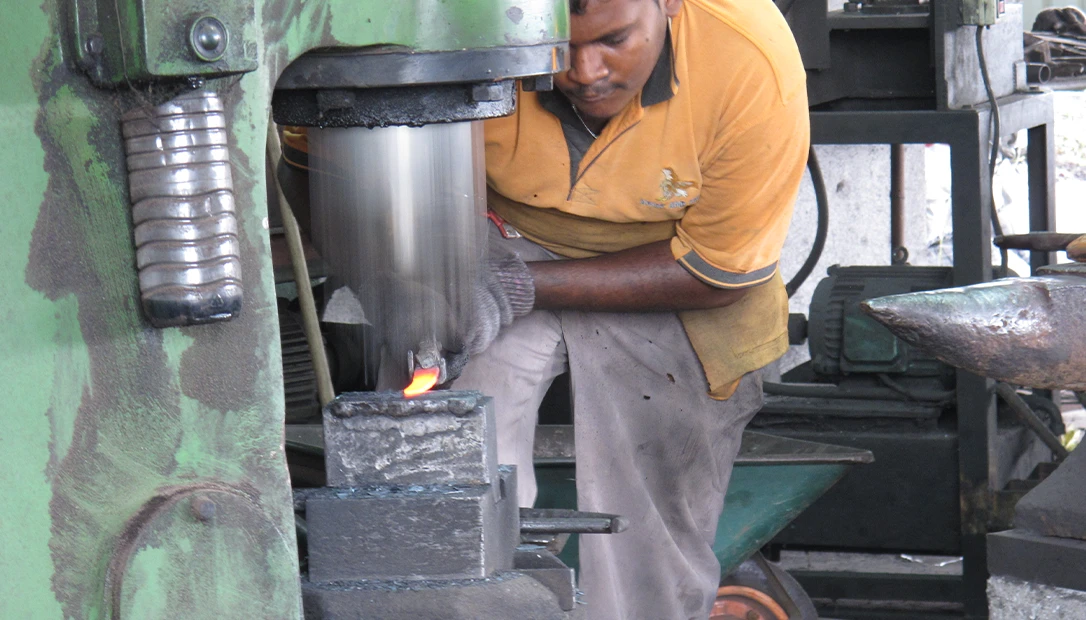
The forge reminded me of those I had seen in the Philippines, yet the differences stood out. Blade shapes carried their own Thai identity, and the fuel was distinctive—charcoal and bamboo. Bamboo charcoal burns hot, producing the intense heat needed to shape steel into the iconic Aranyik blades.
The smiths worked with 5160 leaf spring steel, hammering it on a small, ground‑set anvil. Their hammers were simple metal blocks strapped to bamboo handles with leather. Crude in appearance, but the craftsmanship spoke volumes. Many knives carried the one‑piece tube handle design seen in the Philippines and Vietnam, where continuous steel construction adds strength. Unlike the rattan‑wrapped grips of Filipino bolos, Thai handles were bare. Sweat could make them slick, but in practice, they held firm. These blades are for coconuts, firewood, and heavy chopping, with forward‑weighted balance and edges sharp enough to bite deep.
Advertisement — Continue Reading Below
Traditional Hand-Forged Thai Blades
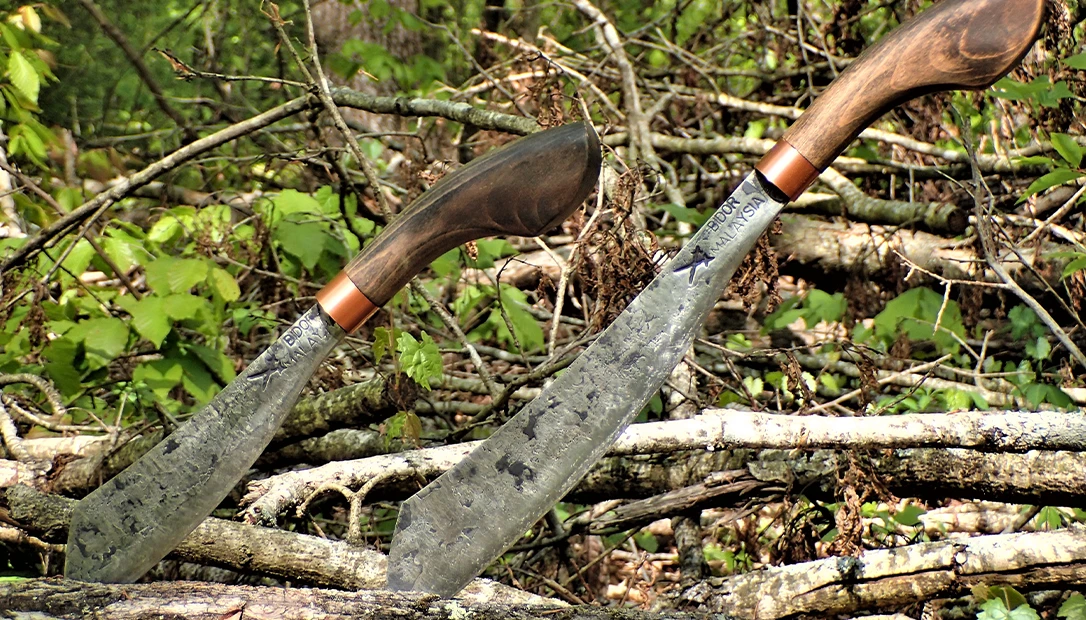
Two hand‑forged blade forms dominated the forge—the E‑Nep and the E‑Toh. Both are deeply rooted in Thai tradition and found in markets throughout the region. The E‑Nep, in particular, has become Thailand’s calling card. Production companies often replicate it, branding it as the country’s big chopping knife.
The E‑Nep carries a profile reminiscent of the kukri of Nepal, but with its own twist. Unlike the stick tangs common elsewhere, the Thai version uses a full tang construction. Hardwood scales are pinned or epoxied to the tang, which runs the full length and width of the handle. Exposed along the belly, butt, and spine, the tang adds strength and durability. This design ensures the grip won’t loosen or fail, even under heavy use. The result is a robust chopper, a blade that blends tradition with modern resilience.
Strength in Simplicity
In Aranyik, I realized the genius of these tools lay not in polished finishes or elaborate handles, but in their raw functionality. The smiths worked with what they had—small anvils, bamboo‑handled hammers, and charcoal fires—and produced blades that could stand up to the hardest tasks.
These knives weren’t for display cases. They were built for work: splitting coconuts, chopping firewood, and cutting through the daily grind of rural life. Their balance leaned forward, their edges were frighteningly sharp, and their construction was solid. In every strike of the hammer on steel, I saw a tradition carried forward, proof that heritage lives not in museums but in the hands of those who still forge it.
Durability
Stick‑tang choppers often raise doubts, especially among Western users who insist on full‑tang construction. Production companies rarely offer stick‑tang parangs, goloks, E‑Neps, or bolos, instead releasing heavy full‑tang machetes that mimic the look but miss the authentic feel. Condor Tool and Knife produces rustic patterns, yet the added steel makes them heavier than the originals. True Southeast Asian blades are light, forward‑balanced, and tapered toward the tip for speed and bite.
Some custom makers forge closer to tradition, even experimenting with stick‑tang builds reinforced by pins. Still, westerners struggle to trust them for chopping, batoning, or digging. In Southeast Asia, these tools endure outdoor storage and hard use. Centuries of proven performance show the design works.
End of the Journey?
As my travels ended, I realized the journey had only begun. What started as a search for hand‑forged blades grew into a lifelong passion for long knives and their countless patterns. Each forge and marketplace revealed only fragments of the story. Authentic blades carry culture, history, and utility in every strike, and there are still many styles left to discover. My quest is far from finished. One thing is certain—I will continue the search!
The post Forged Heritage: Hand-Forged Blades appeared first on Athlon Outdoors Exclusive Firearm Updates, Reviews & News.